

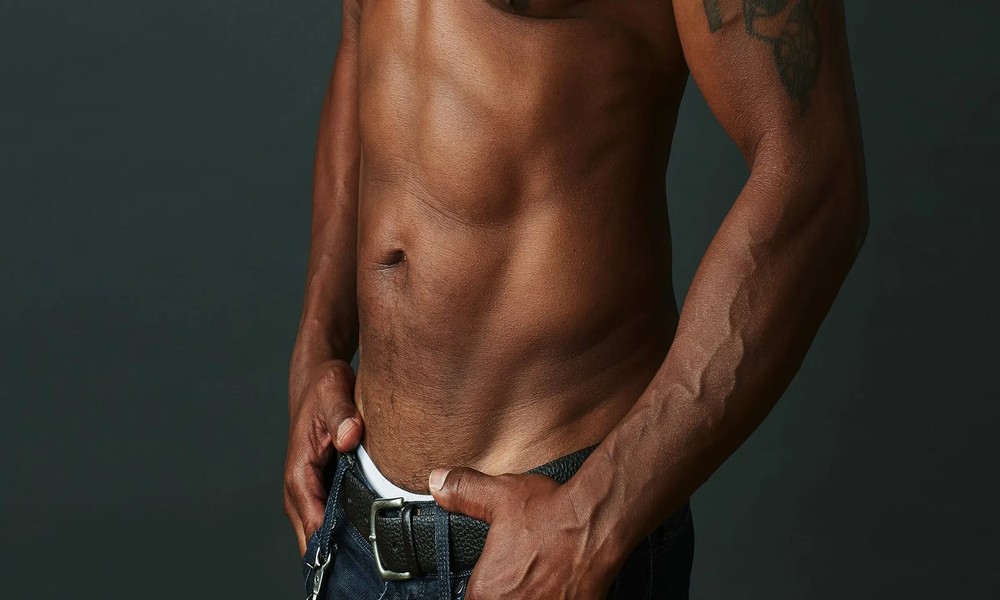
For most men, the adonis belt becomes visible at 12-15% body fat. The inguinal ligament groove emerges once subcutaneous fat in the lower abdomen thins enough to reveal the anatomical structure beneath. Getting there requires understanding why this region resists conventional fat loss and addressing the specific hormonal and receptor conditions that protect lower belly fat.
Understanding what the adonis belt actually requires – and why lower belly fat resists standard approaches – is covered in depth in this guide to signs of adonis belt development, which explains the full hormonal and anatomical picture.
At What Body Fat Percentage Does the Adonis Belt Become Visible?
The adonis belt becomes visible when the subcutaneous fat layer over the lower abdomen is thin enough to reveal the inguinal ligament groove beneath. There’s no single universal percentage because fat distribution varies between individuals – but the general ranges are:
- Under 15% body fat: The adonis belt may begin to show faintly in some men, particularly those with genetically favourable fat distribution
- 12-14% body fat: The adonis belt becomes visible for most men, especially with developed surrounding musculature
- 10-12% body fat: The adonis belt is clearly defined for the majority of men
- Below 10%: The adonis belt is prominent and well-defined, with visible separation
These ranges assume average fat distribution genetics. Men who carry more fat in the lower abdominal region may need to reach the lower end of each range for visibility. Lighting and hydration status also matter – the groove becomes more pronounced when subcutaneous water retention is low, which is why some men see it transiently in the morning or after a sauna but not consistently throughout the day. Consistent visibility requires reaching the appropriate body fat threshold, not chasing transient conditions.
Why the Lower Belly Is Always the Last Place Fat Disappears
If you’ve ever noticed that your face, arms, and chest lean out while your lower abdomen stays stubbornly covered, this is not random. It’s driven by receptor biology.
Fat cells throughout the body carry two types of adrenergic receptors – beta receptors, which accelerate fat release when stimulated, and alpha-2 receptors, which inhibit fat release. The distribution of these receptors is not uniform across the body. Different regions have different beta-to-alpha ratios, and this ratio determines how readily that area releases fat when the body is in a caloric deficit.
The lower abdominal region – precisely where the adonis belt needs to emerge from – has one of the highest alpha-2 receptor densities in the male body. The alpha-2 to beta ratio in this area can be as high as 10:1. This means the fat cells covering the adonis belt are biologically resistant to the catecholamine signals (adrenaline, noradrenaline) that drive fat mobilisation elsewhere in the body.
A compounding factor is blood flow. Alpha-2 receptor activation causes vasoconstriction in local adipose tissue, so the lower abdominal region receives less blood flow during lipolysis than high-beta areas like the chest or face. Even when catecholamines trigger fat release from these cells, the released fatty acids are carried away more slowly. This means systemic conditions affecting catecholamine levels and circulation have a disproportionate impact on how quickly stubborn lower belly fat responds – more so than in any other region of the body.
The Hormonal Environment Governing Adonis Belt Fat
Insulin is the key hormonal gatekeeper for lower abdominal fat. Chronically elevated insulin levels suppress hormone-sensitive lipase (HSL) – the primary enzyme responsible for breaking down stored triglycerides in fat cells. In alpha-2 dominant regions like the lower abdomen, HSL activity is already inhibited by the receptor profile. Add chronically elevated insulin and fat mobilisation in this area slows to nearly zero.
This is why approaches that focus solely on caloric restriction often stall before the adonis belt becomes visible. The caloric deficit creates systemic fat loss, but the hormonal and receptor environment in the lower abdominal region continues to protect those fat stores.
Cortisol is the second major hormonal obstacle. Chronic stress elevates cortisol, which promotes visceral fat accumulation and simultaneously increases alpha-2 receptor expression in the lower abdomen. This creates a dual problem: the fat depot grows while the receptor profile becomes even more resistant. This is not a minor effect – chronically elevated cortisol can maintain lower abdominal fat even at body fat percentages where most men would otherwise show visible inguinal definition. Managing sleep, training stress, and recovery is not optional detail when targeting this region; it directly affects whether cortisol remains elevated enough to maintain that fat depot regardless of your caloric position.
BellyProof’s hormonal fat loss approach specifically addresses this receptor environment, targeting the conditions under which alpha-2 dominant fat stores can actually be mobilised – rather than simply creating a generic caloric deficit.
Signs That Your Adonis Belt Is Emerging
Before the adonis belt is fully visible, there are intermediate signs that fat loss is progressing in the right direction:
- The area above the hip bone begins to show definition
- The lower abdominal region starts to look flatter and less rounded
- A faint line or groove becomes visible on one or both sides when under good lighting
- The “overhang” above the waistband of shorts or underwear reduces significantly
- Vascularity begins to appear in the lower oblique region
Progress in this area is often non-linear. You may notice rapid changes in visible vascularity or oblique definition weeks before the inguinal groove itself becomes clear. This is because the fat layer over the obliques and the iliac crest is typically thinner and has a less extreme alpha-2 profile than the tissue directly over the inguinal ligament. Treat early oblique definition as a reliable signal that you’re within range, not as stalling – the central groove usually follows within a few percentage points.
How to Accelerate Adonis Belt Visibility
Given the receptor biology, a multi-pronged approach is more effective than simply maintaining a caloric deficit:
Manage Insulin Strategically
Periods of low insulin – through fasted training, time-restricted eating, or carbohydrate cycling – create windows where alpha-2 dominant fat stores become more accessible. This isn’t about eliminating carbohydrates; it’s about timing them to create consistent periods of low insulin where fat mobilisation can actually occur. A practical implementation is training in a fasted or low-insulin state at least three times per week, placing carbohydrate intake in the post-training window rather than pre-training, which allows the training session itself to operate under conditions where HSL suppression is minimal.
Prioritise Training That Maximises Catecholamine Response
High-intensity resistance training produces the largest catecholamine response of any training modality. This matters for stubborn lower abdominal fat because catecholamines are the primary signal driving fat mobilisation – and the lower abdomen needs a strong enough signal to overcome its alpha-2 resistance. Compound movements performed at high intensity (working sets near failure, short rest periods of 60-90 seconds) produce significantly higher adrenaline output than moderate-intensity steady-state cardio. The common advice to do more cardio to lose lower belly fat is mechanistically backwards – the catecholamine signal from cardio is weaker, not stronger, and the lower abdomen requires the opposite.
Develop the Surrounding Musculature
Once the body fat percentage is low enough, the visual impact of the adonis belt is significantly enhanced by developed obliques, hip flexors, and lower abdominal muscles. Training these areas while pursuing overall fat loss means the adonis belt makes a strong visual statement when it finally emerges. Developed obliques create a visual frame that deepens the apparent groove of the inguinal ligament, and hypertrophy in the serratus anterior and lower rectus adds structural depth to the entire lower torso. This musculature doesn’t reveal the adonis belt – only fat loss does that – but it determines how pronounced it looks once the fat is gone.
Realistic Timeline: What to Expect Week by Week
Men starting at 20% body fat can expect the adonis belt to become faintly visible approximately 16-24 weeks into a well-structured fat loss protocol, assuming a rate of loss of roughly 0.5-1% body fat per week. That timeline assumes the hormonal environment is managed correctly – insulin, cortisol, and catecholamine response all addressed rather than just calories. Men starting at 17-18% are typically 8-14 weeks away at the same rate.
These timelines assume consistent fat loss without metabolic adaptation stalls. Adaptation is common after 8-12 weeks of continuous deficit and manifests as a plateau driven by reduced NEAT and a downward shift in resting metabolic rate. Diet breaks of 1-2 weeks at maintenance calories reset leptin signalling and restore metabolic rate more effectively than prolonging the deficit past the adaptation point. One planned diet break every 8-10 weeks is a structural choice, not a concession.
The Bottom Line on Adonis Belt Body Fat Requirements
For most men, 12-14% body fat is the target range where the adonis belt begins to show clearly. Getting there requires both overall fat loss and an understanding of the hormonal environment that governs lower abdominal fat specifically. Generic dieting approaches will get you part of the way – but addressing the receptor biology, managing insulin and cortisol, and producing a sufficient catecholamine response through high-intensity training is what gets you the rest of the way. The biology of this region is not a barrier that makes the goal impossible; it’s a set of conditions that, once understood, gives you a precise roadmap for what to do differently.
Frequently Asked Questions
What body fat percentage do I need to see my adonis belt?
For most men, the adonis belt becomes visible between 12-15% body fat, with clear definition typically appearing at 12-14%. The exact threshold depends on your fat distribution genetics – men who carry more lower abdominal fat may need to reach the lower end of this range.
Can I see my adonis belt at higher body fat percentages?
It’s possible at 15-17% if you have favorable genetics and low lower abdominal fat storage, but this is the exception. The inguinal ligament groove requires genuinely lean tissue in that region, which rarely appears above 15% for most men. Transient visibility (morning hydration, post-sauna) isn’t the same as consistent visibility.
Why is my lower belly fat the last place to lose fat?
The lower abdominal region has one of the highest densities of alpha-2 receptors in the male body – these receptors inhibit fat release. With an alpha-2 to beta ratio as high as 10:1, this area is biologically resistant to the catecholamine signals that mobilize fat elsewhere. This is why spot reduction doesn’t work and why systematic hormonal management matters for this specific region.
How long will it take to see my adonis belt?
Men starting at 20% body fat typically need 16-24 weeks to see the adonis belt faintly, assuming a loss rate of 0.5-1% body fat per week with proper hormonal management. Starting at 17-18% usually means 8-14 weeks. These timelines assume insulin, cortisol, and catecholamine response are managed correctly, not just calories.
