

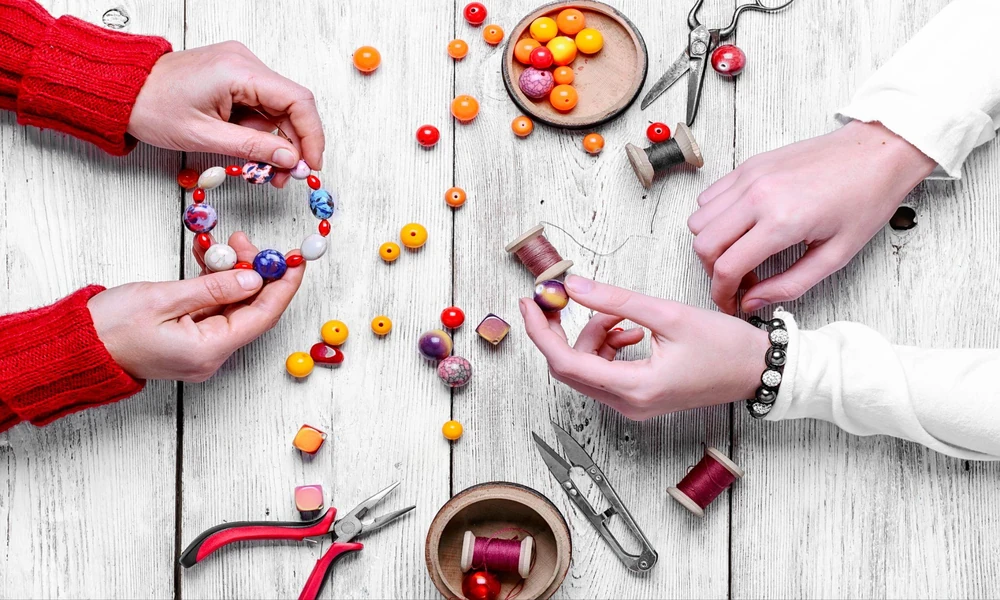
Weekend workshops get booked for a reason people rarely state directly: a few hours doing something with your hands where a phone is impractical and the task occupies just enough attention to crowd out everything else. Whether that actually works depends less on the craft itself than on whether it matches how your particular mind settles. Some people need a repetitive, structured task with a predictable endpoint; others need something loose enough that there is nothing to get wrong. Four formats cover most temperaments, and knowing which suits you is the difference between a restorative afternoon and three hours of quiet irritation you paid for.
1. Beading and Jewellery Making
Highly structured, repetitive, and almost entirely under your control from start to finish. The task involves selecting components, planning a sequence, and threading, with small decisions throughout and no dramatic moments where everything could go wrong.
This suits people who settle through repetition and who find genuine comfort in a task with a clear endpoint they can see approaching. It also suits anyone who wants to talk while working, since the activity does not demand continuous concentration once a rhythm establishes itself, which makes it a reasonable choice for a group who came as much for the company as the craft.
A beading workshop in Singapore is among the more forgiving options for a complete beginner, since mistakes are reversible and nothing sets permanently while you are still deciding whether you like the arrangement. For anyone nervous about not being creative enough, that reversibility removes most of the anxiety before it starts.
2. Fluid Acrylic Pouring
Almost the opposite proposition. Colours are mixed, the pour happens, and the result emerges from how the paint moves rather than from any precise control on your part.
The appeal sits in the moment of release, and it suits people who find structured tasks tiring rather than calming. Anyone searching for fluid acrylic paint pouring near me in Singapore for stress relief is usually looking for exactly that quality of letting go, and the sessions tend to be shorter and more immediately satisfying than a detailed craft, though the finished piece requires curing time before it can be collected rather than going home that afternoon.
It suits people who are comfortable with an unpredictable outcome considerably better than it suits anyone who arrived with a specific result in mind, since influencing the paint is possible and controlling it is not.
3. Clay and Hand-Building Pottery
Slow, tactile, and physically engaging in a way that few other crafts manage. Working clay involves both hands continuously and produces a form that changes gradually under them, which is absorbing in a way that is difficult to explain to anyone who has not tried it.
This suits people who hold tension physically and who benefit from something that occupies the hands completely rather than partially. It is messier than the alternatives and generally requires firing afterward, so the finished piece is collected days or weeks later, which is worth knowing before booking if you want something to take away.
4. Textile Work: Weaving, Embroidery, or Macramé
Repetitive, rhythmic, and portable, which means the skill learned in a session continues at home afterward with inexpensive materials.
These suit people who want an activity that extends beyond the workshop itself rather than a one-off experience to tick off. The learning curve is gentle, progress is visible within the session, and the pace is entirely self-determined, which appeals particularly to anyone who dislikes feeling rushed or watched while learning something new.
Choosing Based on How You Actually Unwind
The honest question is whether you relax through structure or through release, and most people know the answer once it is put that way. Someone whose working week involves constant decisions often finds a repetitive, prescribed task genuinely restful. Someone whose week is monotonous frequently wants the opposite and leaves a structured craft session feeling no different from when they arrived.
It is also worth settling a few practical details before booking: how long the session runs, whether you leave with a finished piece or collect it later, whether the format suits conversation or requires quiet concentration, and whether anyone in your group has sensitivities to the materials involved, which is a question for the studio rather than something to assume either way. Trying one of each across a few months is a reasonable approach, since most people are mildly surprised by which one they end up going back to.
Contact Kaleida Studio to discuss which workshop format would suit how you prefer to spend an afternoon.
