

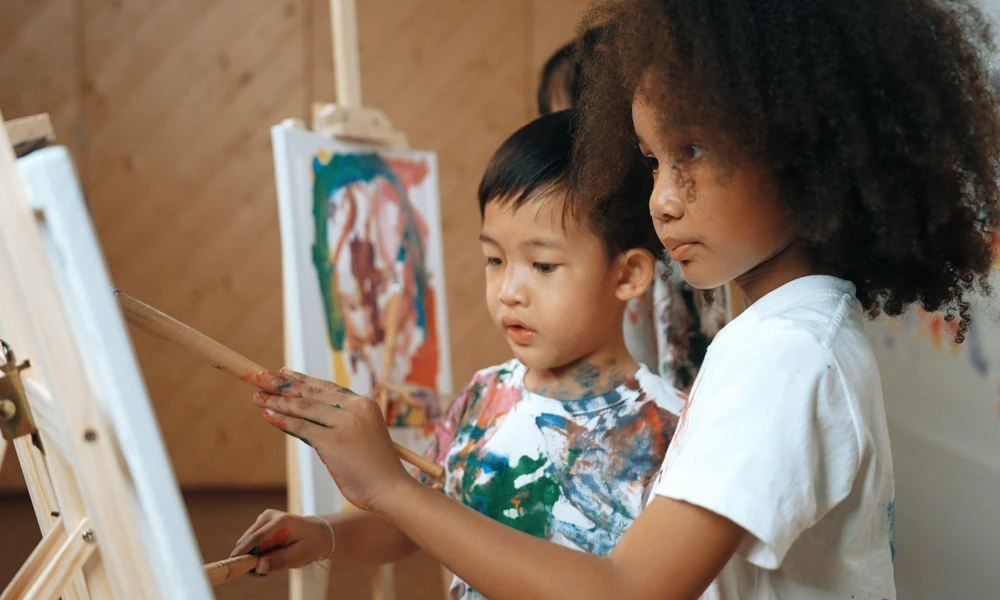
A room full of children with paintbrushes doesn’t automatically mean they’re creating together, and the difference between genuine collaborative art and simply painting side by side often gets lost when planning a children’s art class or group activity. Understanding what actually separates the two matters for choosing the right format for the outcome you want, especially when the goal is a specific skill like teamwork rather than just filling an afternoon with paint.
What Collaborative Art Actually Means
Collaborative art involves participants actively shaping a single, shared outcome together, rather than each person working toward their own separate result.
- Contributions from different participants physically overlap or connect on the same canvas or surface.
- Decisions about colour, composition, or direction are made jointly, often requiring discussion or compromise.
- The finished piece can’t easily be separated into individual sections attributable to just one person.
- Success depends on participants responding to what others have already added, rather than working in isolation.
- Participants often need to communicate about who will handle which section, or how colours and shapes will transition between one contribution and the next.
- The process often includes moments of adjusting a personal idea to fit what the group has already created, which is a skill in itself.
What Simply Painting in the Same Room Actually Means
Painting in the same room, by contrast, is really just shared physical space rather than a shared creative process.
- Each participant works on their own canvas, page, or section with no expectation of building on anyone else’s work.
- Conversations, if they happen, are incidental rather than needed to complete the activity.
- The final results are individual pieces that could just as easily have been produced separately.
- Skill development stays focused on personal technique rather than negotiation or shared decision-making.
- Materials and space are typically shared purely for convenience, such as easier supervision or cleanup, rather than for any creative purpose.
- Because there’s no dependency between contributions, a child can leave partway through without changing what anyone else has produced.
Comparing the Two Formats
| Aspect | Collaborative Art | Painting in the Same Room |
|---|---|---|
| Outcome | One shared piece | Multiple individual pieces |
| Interaction required | Yes, throughout the activity | Minimal or incidental |
| Decision-making | Joint, often negotiated | Individual |
| Best suited for | Group bonding, communication skills | Individual skill practice |
This comparison reflects the general distinction, since some activities blend elements of both depending on how they’re structured.
Why This Distinction Matters When Choosing an Activity
Getting this distinction right matters most when the goal extends beyond simply keeping children occupied with paint, particularly for something like paint team building, where the entire point is the interaction itself.
- A genuinely collaborative format builds communication and compromise skills that parallel painting simply doesn’t require.
- Choosing the wrong format can leave a group activity feeling more like supervised solo time than actual teamwork.
- Facilitators need to structure the activity deliberately, since children won’t automatically collaborate just because they’re sharing a table.
- Adults observing the session can misjudge its value if they assume shared space alone counts as teamwork, when nothing about the process actually required it.
Choosing the Right Format for the Goal
Knowing whether an activity is genuinely collaborative or just happening in shared space makes it much easier to match the format to the actual goal, whether that’s team bonding or individual creative practice. Asking how the finished piece will look, and whether participants need to interact to complete it, is usually the fastest way to tell the two apart before committing to one. This is especially worth confirming with a facilitator or instructor beforehand, since an activity’s title alone doesn’t always reveal which format is actually being delivered on the day.
Book a session with Kaleida Studio today, where every project is designed around genuine group collaboration.
